
PLANET. Living on the edge, changing the economy
The afternoon starts from an uncomfortable point: the climate crisis cannot be solved with a few technical adjustments. “For too long, we have treated natural capital – forests, oceans, soils, biodiversity – as a backdrop to growth, an unlimited and priceless input,” observes Valentina Bosetti, professor of Environmental and Climate Change Economics at Bocconi University. “Ignoring its value is not only a moral error: it is an accounting distortion that misguides our choices and can turn into a historic mistake.”
GDP, Bosetti points out, is a powerful but partial tool. “It's like driving an electric car while only looking at the speedometer and ignoring the battery range.” We can grow in speed without realising that we are consuming the capital that makes the journey possible. Climate change marks the end of the illusion that production and consumption can proceed without limits.
This reflection is intertwined with that of Partha Dasgupta on the ‘price of nature’ and the urgency of integrating natural capital into economic models. This is not an academic quirk: it is a matter of systemic survival.
People on a changing planet
But climate is not just a matter of indicators. It is a force that is already redrawing the distribution of the population on Earth. Raya Muttarak, a demographer at Bocconi University, makes it clear: extreme temperatures, water scarcity and floods affect health, livelihoods, reproductive choices and mobility. And they do not affect everyone in the same way.
Vulnerability, education and human capital make the difference between those who suffer and those who manage to adapt. Migration is never a single-cause decision: it is the result of intertwined climatic, economic, social and informational factors. In the most fragile contexts, environmental shocks add to systems already under pressure, transforming the climate into a multiplier of instability.
The panel involves Michael Joseph Puma (Columbia Climate School – Columbia University), Kamal Amakrane (Climate Envoy of the President of the UN General Assembly, Managing Director @UN GCCM) and Salvatore Sortino (Director of the Coordination Office for the Mediterranean, International Organisation for Migration) and will broaden the perspective: talking about “climate migrants” without analysing the structural conditions risks simplifying a phenomenon that is much more complex – and political.
Cities on the edge
The change is most evident in cities. Over 70% of global greenhouse gas emissions are linked to urban systems, which are also the most vulnerable to heat waves, floods and housing pressures.
Edoardo Croci, director of SUR Lab Bocconi, points out that cities are both responsible for and a laboratory for solutions. “Climate, mitigation and adaptation policies are increasingly guiding urban planning choices in the medium to long term in a strategic way.” Energy, mobility, construction, land use: everything is changing.
The ‘15-minute city,’ the European Climate City Missions, and the Climate City Contracts – such as the one involving Milan – are not urban slogans, but concrete attempts to integrate the environment, inclusion, and development. Urban regeneration can generate measurable social value, but only if the public and private sectors engage in transparent dialogue and use credible indicators. And Croci will discuss this with Thomas Osdoba, Managing Director of NetZeroCities, and Anna Lisa Boni, Councillor for the Municipality of Bologna and former Secretary General of Eurocities.
Alongside the technical analysis, Andrea Pennacchi brings the human dimension to the fore: living in a changing environment also means feeling like a stranger in familiar places. Along the same lines is the contribution of Fatou Jeng (founder of Clean Earth Gambia), who shows how adaptation can become an active choice, guided by knowledge and youth leadership, in the contexts most exposed to the climate crisis.
Health of the planet, health of people
In the evening, the discussion comes full circle. “Regenerating the world” is not just an evocative title: it is a proposed method. Climate, energy, health and the economy are all part of a single system.
Bosetti returns to a key point: measuring the health of the planet means measuring our capacity for the future. The human cost of the climate crisis – recalled by the experience of Jagan Chapagain, CEO and Secretary General of the International Federation of Red Cross and Red Crescent Societies – makes it clear that we are not talking about distant scenarios, but about real lives.
Regenerative leadership, discussed by Paolo Taticchi and the protagonists of sustainable innovation (Sharon Cittone, Founder and CEO of Edible Planet Ventures, Roberto Carnicelli, Co-Founder & CEO, Eoliann, Eric Ezechieli, co-founder of Nativa), attempts to overcome the dichotomy between profit and impact. From food to climate data, new businesses are experimenting with models in which prevention, adaptation and competitiveness are not alternatives.
Living on the edge
The takeaway is clear: the edge is not a theory. It is a material condition. “Living on the edge is not a sacrifice, but a form of collective intelligence”.
The evening ends by intertwining science, business and imagination. If the health of the planet coincides with that of people, then measuring natural capital, rethinking cities and strengthening the resilience of communities are not separate chapters, but parts of the same agenda. And alongside economists and policy makers, there is room for a new generation of activists and innovators: Carl Philip Dybwad, Chief Operating Officer of Climate Cardinals and Arctic Climate Youth Champion, highlights the role of creativity and youth mobilisation in translating scientific data and climate urgency into concrete action.
The Planet day does not end with a generic call for sustainability. It questions the very idea of progress. If the health of the planet is a prerequisite for human health, then economics, politics and culture must realign themselves with this evidence.
The final question is not whether change is possible. It is whether we are willing to do it in time.
Explore our Focus 'Pact4Future 2026'
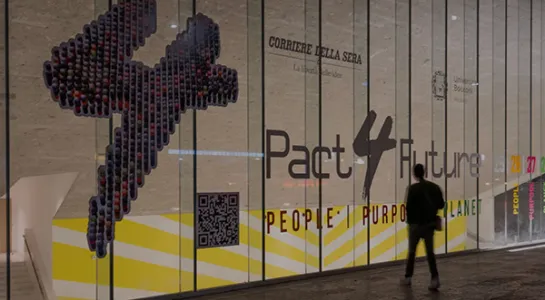
Interdependent. People, choices, planet
From March 24 to 26, Bocconi and Corriere della Sera return with the third...