
Don’t Call Us Hippies: We’re Talking Economics
At the end of class, students have been asking me — more frequently in recent times — whether it is truly realistic to think we can solve the climate crisis by changing just a few mechanisms in the dominant economic model.
The question stems from observing how the system — even in Europe, the most advanced testing ground for environmental and climate policies — defends itself when change affects structural interests and established revenues. They see the strength of incumbents tied to fossil fuels, the speed with which artificial intelligence — lacking shared governance — increases the demand for energy, and the erosion of multilateralism. The resurgence of geopolitical conflicts weaken the very backbone of cooperation on which climate accords are established. In this context, the slow collective decision-making process is not just an administrative issue — it is systemic.
Is it sufficient to “internalize the externality,” putting a price on carbon and adjusting incentives? Or, is the issue more radical, rethinking what we mean by growth?
For too long we have treated natural capital — forests, oceans, soils, biodiversity — as a backdrop to growth, an unlimited and unpriced input. However, nature is living capital on which we depend. Ignoring its value is a moral mistake, in addition to an accounting misrepresentation that misguides our choices and can turn into a historic failure.
GDP is a powerful tool, but it is not neutral. It is like driving an electric car while looking only at the speedometer and ignoring the battery range. We can accelerate and feel satisfied with the speed, not realizing that we are consuming the energy that makes the journey possible. If we fail to account for the erosion of natural capital, we mistake speed for progress and depletion for growth.
Updating the indicators is not enough; the question is whether a paradigm of unlimited growth, corrected at the margins, is compatible with stringent biophysical limits. Climate change marks the end of an illusion — that production and consumption can continue without limits, and that they are the sole measure of wellbeing. Limits are a material condition.
The issue is cultural and political, as well as environmental. It concerns business leadership, the relationship between innovation and responsibility, and the very definition of prosperity. If the planet’s health indicates humanity’s health, then climate, biodiversity, energy and social cohesion are all part of the same system.
Regenerating does not mean adding a green variable to an unchanged model; it means recognizing that the model must evolve — that living within limits is a form of collective intelligence, not of sacrifice.
Perhaps the question is not whether it is possible, but whether we are willing to do so in time.

Explore our Focus 'Pact4Future 2026'
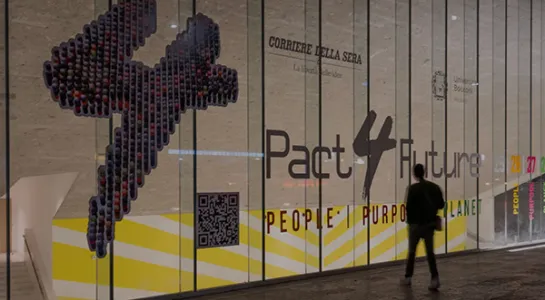
Interdependent. People, choices, planet
From March 24 to 26, Bocconi and Corriere della Sera return with the third...