
PEOPLE. The school that liberates, the generations that choose to join forces
It starts at 3pm in the Sala Buzzati. And it starts with school. Not as a ritual tribute, but as a political and social issue. Because that is where it is decided whether a country expands or restricts its possibilities.
The point is clear: inequalities are not only economic, they are invisible. They lie in the implicit biases of teachers, in the social isolation of those who remain on the margins, in the lower expectations that end up becoming self-fulfilling prophecies. But research also shows that these mechanisms can be corrected.
“Implicit stereotypes and invisible inequalities can hold back the potential of the most vulnerable students,” explains Michela Carlana, an economist at Bocconi University. “However, when schools become aware of their biases and experiment with evidence-based tools – such as targeted tutoring or mapping social isolation – they can become a powerful engine of freedom and social mobility.”
This is not theory. The discussion at P4F brings together those who study these phenomena and those who enter the classroom every day: teachers who have innovated teaching from within, such as Elia Bombardelli, Enrico Galiano and Eleonora Orsi. Joining them is Nicolò Govoni, founder of Still I Rise, who has brought quality schools to the most vulnerable contexts in the world, reminding us that education is not an ancillary service but a right that changes destinies.
The debate then broadens to EdTech: Pasquale Battaglia (Vik School), Antonio Pisante (Yellow Tech) and Letizia Sbarbaro (WeSchool) discuss educational technologies without digital fetishism. The question is simple: does technology serve to bridge gaps or does it risk creating new ones?
There is also room for culture as an educational lever. The Piccolo Teatro di Milano brings the experience of “Il teatro tiene banco” (Theatre takes centre stage): Antigone, Homer and Pirandello reinterpreted to talk about war, digital identity and gender equality. School as a place where the past is not celebrated but questioned.
More generations, more responsibility
In the evening, at 8pm, in the Bocconi Aula Magna, the focus shifts. The discussion is no longer just about students, but about coexistence between different ages. Never before have so many generations coexisted. It is a demographic fact, but also a political one.
“If I have seen further, it is because I stood on the shoulders of giants,” recalls Francesco Billari, Rector of Bocconi University. “Each of us inherits a world we did not choose, but no one starts from scratch. We live within decisions made before us and, at the same time, we build the living conditions of those who will come after us.”
This is not just rhetoric. In Italy, pension expenditure accounts for almost a fifth of GDP, while decisions on debt, climate and education will have an impact that will weigh heavily on those who are in their twenties today – or who are not yet born. “Complex societies often look for scapegoats when they struggle to manage change. Today, all too often, the scapegoat is the other generation,” warns Billari.
The evening intertwines different perspectives on this fragile pact. Volker Türk, UN High Commissioner for Human Rights, recalls the ethical dimension: the bond between generations is first and foremost a question of rights and dignity. Cristina and Francesca Nonino talk about what it means to inherit a business and transform it without betraying its identity. Marco Ogliengo, co-founder and CEO of JetHR, and Silvia Wang, co-founder and CEO of Serenis, bring the perspective of a new entrepreneurship that is trying to rewrite the rules of work, focusing on organisational culture, mental health and the quality of relationships as structural – not accessory – elements of competitiveness. Beppe Severgnini reflects on the art of remaining curious as the world accelerates.
Sport becomes a concrete metaphor for passing the baton with Diana Bianchedi and Giulia Amore, together with Vittorio and Danilo Gallinari: time leaves its mark on the body but sharpens the gaze, and trust between generations is what allows us to push ourselves a little further.
And then there are those who started very early. Ryan Hreljac, founder of the Ryan's Well Foundation, reminds us that age is no excuse: at the age of six, he decided to build a well for those who had no drinking water. Today, he has over 1,700 water projects in 17 countries. Responsibility does not wait for adulthood.
The time we choose to live in
The thread that links afternoon and evening is clear: without serious investment in schools and intergenerational relationships, any discussion of innovation or sustainability remains suspended.
“We cannot choose the era in which we are born,” says Billari. “But we can choose whether to use this unprecedented coexistence between generations as a battleground or as an opportunity for cooperation. The future does not belong to a single age group. It belongs to those who agree to build it together”.
The “People” day offers no consolation. It says one simple thing: the future cannot be defended with slogans about young or old people, but with choices that redistribute opportunities, voices and responsibilities. School as infrastructure, work as a space for care, dialogue as a method.
The rest comes later. First come the people. And the way they decide to exist in time.
Explore our Focus 'Pact4Future 2026'
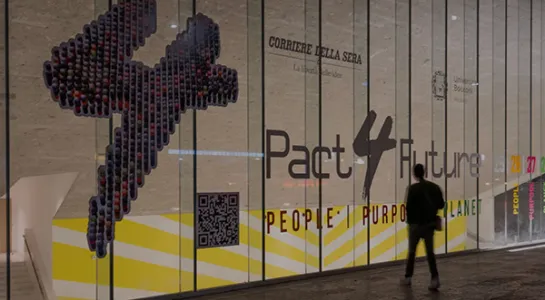
Interdependent. People, choices, planet
From March 24 to 26, Bocconi and Corriere della Sera return with the third...