
School, Inflation and Healthcare: Italians Seek Protection and Fear Decline
Youth distress is deeper than adults think. Inflation is seen as a major loss of well-being. Healthcare remains an absolute priority.
These are the clearest findings emerging from the survey conducted by the Monitoring Democracy Observatory at Bocconi University, in collaboration with SWG, on a representative sample of 2,049 Italians, ahead of the third edition of Pact4Future 2026, taking place from March 24 to 26 (www.pact4future.it).
School: a clear generational divide
51% of young people aged 18 to 24 believe psychological distress among students in Italy is very widespread. The percentage drops to 37% among those aged 45-64—their potential parents—and to 32% among those over 65. Across the entire adult population, the figure stands at 38.5%.
The gap widens when considering the role of schools. 35.7% of young people believe the Italian school system pays no attention at all to students’ emotional and relational well-being. Among 45–64-year-olds, this share drops to 18%.
Differences are also notable regarding solutions: 30.3% of young people see psychological support as the most effective measure to prevent episodes of violence involving knives or dangerous objects in schools. Among 45-64-year-olds, this falls to 17.5%.
“The generational divide about schools is one of the strongest findings of the survey,” says Vincenzo Galasso, director of the Monitoring Democracy Observatory. “Young people perceive much deeper distress and demand more strongly preventive tools and psychological support than adults.”
The message is clear: protecting younger generations is not just an educational issue, but of structural psychological well-being.
Inflation and healthcare: the perceived cost of insecurity
Alongside schools, economic and social priorities emerge strongly. Through an experiment measuring willingness to pay for different policy scenarios, the survey quantifies the “value” Italians attach to stability and public services.
Italians place a value equivalent to approximately €1,066 per month on living in a country where “prices are stable and household purchasing power remains constant” compared to one where “prices are rising rapidly and purchasing power is declining” (assuming an average income of €1,750).
To have a healthcare system where waiting times for non-urgent visits and tests are 30 days instead of 90, the average willingness to pay is €520 per month, rising to €635 among those over 65.
“Inflation is perceived as an enormous loss of well-being, greater than any other dimension tested,” explains Galasso. “Healthcare comes immediately after. These are the two pillars of everyday security. The demand that emerges is material, not symbolic.”
A country that fears decline
Looking at the economic future, the picture is not reassuring. Italy currently ranks 26th in the world in terms of GDP per capita. In twenty years, without structural reforms, Italians estimate a median position of a 30th place.
Stagnation is not expected, decline is. In public perception, decline is the likely scenario without structural choices.
“The data on the economic future are consistent with the priorities that emerged,” comments Galasso. “If present-day protection is central and growth is not taken for granted, it means people directly link reforms to the country’s projected direction.”
War and climate: global instability as the backdrop
When asked which changes in Italy and the world are most concerning, the answer is clear: war is cited by about one-third of respondents. It is the dominant fear.
This is followed by a cluster of systemic risks: climate change, the quality of democracy, immigration and crime, each mentioned by 7-10%. Climate change consolidates its position as the second major category of global concern, especially among higher-income groups, where it carries even greater weight.
“War dominates the emotional horizon, but climate change emerges as a structural risk,” Galasso notes. “It is no longer perceived as a distant or specialist issue: it has firmly entered among the main concerns, alongside democratic quality and international stability.”
Compared to the 2024 survey, where the language of personal economic vulnerability prevailed, the focus has now shifted toward global instability. The economy remains important, but it is no longer the sole center of concern. The emotional horizon has become more international, more systemic, and less tied to the domestic dimension alone.
The Pact4Future debate
The survey reveals a clear common thread: protection in the present, reforms to avoid decline, and governance capacity in a context of global instability.
“These data show Italians are aware of their own fragilities,” comments Francesco Billari, Rector of Bocconi University. “If a majority expects decline without reforms, it means the demand for structural choices is real. The challenge is turning this awareness into decisions.”
“The picture that emerges is clear,” adds Daniele Manca, Deputy Editor of Corriere della Sera. “Inflation, healthcare, schools, war, climate: these are priorities that call for measurable responses. Data help bring public debate back to what truly matters to citizens.”
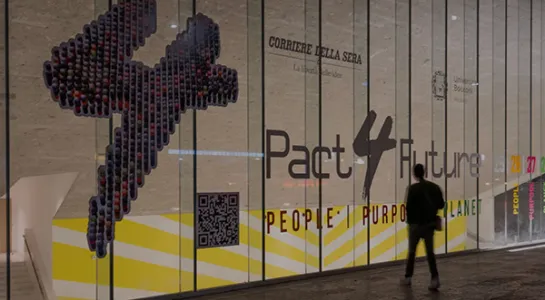
Pact4Future 2026 exists within this framework. Organized by Bocconi University and Corriere della Sera, the forum will bring together over 60 economists, social scientists, policymakers, businesses, and civil society representatives from March 24 to 26, 2026, to discuss—along the three axes of People, Purpose, and Planet—the choices that can shape the country’s trajectory.
A discussion grounded in concrete priorities emerging from data. The Monitoring Democracy survey provides the empirical basis; Pact4Future is the space where that evidence becomes public debate and shared responsibility.
The Avant-premiere of Pact4Future 2026

The results of the survey "Italy Facing the Future", conducted by Bocconi’s Monitoring Democracy Observatory in collaboration with SWG, were presented during the preview of the Pact4Future forum by Vincenzo Galasso, director of the Department of Social and Political Sciences and of Bocconi’s Monitoring Democracy Observatory. Discussing the findings were: Chiara Albanese, Bloomberg’s Italy bureau chief; Francesco Billari, rector of Bocconi University; Valentina Bosetti, director of the Department of Economics and professor of environmental economics at Bocconi University; Giuseppe De Bellis, journalist and vice president of Sky Italia; Francesca Gambarini, journalist at L'Economia of Corriere della Sera, Daniele Manca, deputy editor of Corriere della Sera, Myrta Merlino, journalist, author, and host, Gianmario Verona, professor of innovation management at Bocconi University, and Serena Sileoni, associate professor of constitutional law at Suor Orsola Benincasa University in Naples


Explore our Focus 'Pact4Future 2026'
Interdependent. People, choices, planet
From March 24 to 26, Bocconi and Corriere della Sera return with the third...