
PURPOSE. When the Meaning of Business Stops Being Just a Slogan
In the afternoon, in the Sala Buzzati at Corriere della Sera, the atmosphere is less celebratory and more demanding. The focus is clear: purpose is under pressure. New European rules on sustainability reporting have raised the bar. What was storytelling just a few years ago is now accountability.
“For decades, we thought of business as an instrument to maximize shareholder profit. Today, that vision is no longer enough,” observes Annalisa Prencipe, KPMG Chair in Accounting at Bocconi University. “Sustainability has become central to corporate purpose: it is not a cosmetic addition, but a redefinition of the ‘why’ of the business. Creating value, yes, but in an ecosystem made of employees, suppliers, customers, territories, and institutions.”
The decisive step is reporting. “It’s not about publishing a document at the end of the year. Reporting means measuring and measuring oneself. It means choosing what is truly relevant, translating risks and opportunities into objectives, principles into indicators, and statements into operational plans with clear roles and responsibilities.” When ESG indicators enter control systems and public reports, they change daily behaviors, guide managerial decisions, and affect investment choices.
Transparency, Prencipe emphasizes, “creates accountability inside and outside the company.” It strengthens the trust of investors, banks, customers, and talent. But it also exposes companies to concrete risks. “Reputation is a double-edged sword: poorly calibrated or unsupported goals can backfire. The line between credible commitment and greenwashing is thin, and the market is becoming less and less forgiving.”
Between accountability and legal responsibility
The critical point is precisely this: where does credible reporting end and greenwashing begin? Marco Ventoruzzo, full professor of commercial law at Bocconi University, urges us to separate the managerial and legal domains. “When corporate purpose enters the regulatory framework, made of duties and responsibilities, difficulties inevitably arise: precise definitions, clear parameters, and criteria for assigning responsibility are needed.” Broad formulas work at conferences, but much less so in court. Ventoruzzo discusses this with Federica Calvetti (ESG Coordinator, Eurizon) and Damaso Zagaglia (Vice President - EMEA Sales, ISS Corporate).
In Europe, where sustainability has become a permanent feature of corporate reporting with increasingly detailed standards, the challenge is also organizational and cultural. For large companies, it is a structural change; for SMEs, it may look like a costly burden. “The risk is that reporting will be seen as a bureaucratic requirement foisted from above. But it can become a management tool: helping to structure processes, improve dialogue with banks and customers, and strengthen the position in international supply chains.”
Ultimately, the issue remains cultural. “If the purpose remains tied to the short term and solely to shareholder logic, sustainability will always be a formal exercise. If, on the other hand, the company truly takes a long-term, stakeholder-oriented perspective, then reporting becomes part of the strategy. It is not a narrative of what is being done. It is the perimeter within which value is created.”
A second round table brings together Andrea Dossi, director of the SRB Lab Bocconi, with representatives from Fairtrade, La Galvanina, and Labomar. The issue is quite clear: what is the difference between large, medium, and small businesses? The new rules do not affect everyone in the same way, but no one is really outside their scope. For SMEs, reporting means organizational costs, new skills, and redefining processes. But it also means access to credit, continued presence in international supply chains, and reputation.
The afternoon also featured the Sustainability Report Award ceremony promoted by Buone Notizie del Corriere della Sera, which for years has been selecting and promoting companies capable of turning reporting into a tool for substantial, rather than formal, transparency. A clear signal: sustainability is no longer an appendix to the financial statements, it is part of the financial statements.
The message that emerges is unforgiving: purpose today comes at a cost. But the lack of purpose, or its opportunistic management, can cost much more.
Super-innovation: growing, but towards what?
In the evening, in Bocconi’s Aula Magna, the discussion shifts from obligation to direction. If in the afternoon purpose was put to the test of numbers, now it is being put to the test of the future.
“We live in an era of super-innovation,” says Gianmario Verona, Romeo and Enrica Invernizzi Professor of Innovation Management at Bocconi. “Never before have science, technology, and business moved so fast. Yet, just as we accelerate, we risk losing direction.” The paradox is that we know how to do almost everything, but we don’t always know why we do it.
Verona invites us to “return to Einstein’s home,” not to celebrate an icon but to recover a method: imagination and rigor, creativity and responsibility. Without a compass, artificial intelligence and biotechnology remain powerful tools; with direction, they become levers of human progress.
The discussion on “Unicorns with Purpose” – with Alberto Dalmasso (Satispay), Luca Ferrari (Bending Spoons), and Uljan Sharka (Domyn) – addresses the issue from the founders’ perspective: is it possible to grow to a billion-dollar valuation without losing consistency? Is growth just scale or also giving back? Alongside them, Veronica Squinzi, CEO and Director of Global Development at the Mapei Group, reports on the perspective of an industrial and family-owned company that innovates over the long term, where purpose is not a pitch promise but a choice that affects corporate culture, investments, and the relationship with the local area. Matthias Notz, CEO and Managing Director of German Accelerator and CEO of Start2 Group, broadens the view to the German ecosystem: purpose as a competitive advantage built on interaction between universities, institutions, investors, and businesses.
The capital perspective comes from Luciano Balbo (Oltre Impact): impact investing is not philanthropy in disguise, but a different way of assessing risks and returns. And science, with Mauro Ferrari (University of Washington), reminds us that the most radical innovation—from nanotechnologies to frontier medicine—is only legitimate when it actually improves people’s lives.
Chiara Montanari, the first Italian woman to lead an expedition to Antarctica, takes purpose to the ends of the earth: in extreme contexts, the absence of direction is not a theoretical error, it is an operational risk.
Between market and responsibility
Finally, there is an awareness that the debate on corporate purpose is going through a less enthusiastic and more realistic phase. After years of convergence on increasingly ambitious ESG objectives, costs, implementation difficulties, and geopolitical differences are now emerging. In Europe, regulatory enthusiasm is measured against complexity; in the United States, the issue has become a political battleground; in Asia, more binding approaches are being experimented with.
The point, however, remains intact. “Only what has direction can generate a future,” Verona reminds us. And direction is not a moral abstraction, but a strategic choice that brings together growth, impact, and responsibility.
The “Purpose” day does not end with a reassuring summary. It leaves an open question, but one that cannot be avoided: in an economy that can do almost anything, what is really worth doing?
Explore our Focus 'Pact4Future 2026'
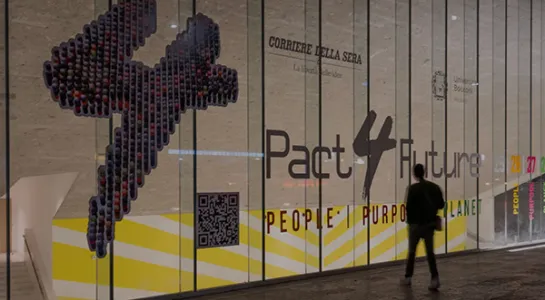
Interdependent. People, choices, planet
From March 24 to 26, Bocconi and Corriere della Sera return with the third...