
Super-Innovation, the Race That Requires a Compass
We live in an age of super-innovation. We combine exorbitant computing power, now reaching the frontier of quantum computers, with small and large data produced over the last thirty years by the web and sensors of all kinds, which can be processed with the intelligence of predictive and generative knowledge algorithms. Powerful computers, accurate data, reliable algorithms: a triangle that fuels our creative, computational and decision-making abilities.
The triangle of super-innovation
And so we are able to do things that were literally unimaginable until recently. Such as folding a protein with a click of a software called Alphafold and enabling biomedical industry researchers to greatly expand their understanding of the mechanisms of disease and thus accelerate the identification of therapeutic solutions. Before the creation of Alphafold and the spin-off produced by Google DeepMind, which led to two computer scientists winning the 2024 Nobel Prize in Chemistry, a laboratory researcher would spend months, sometimes even a whole year, to achieve protein folding.
Industry experts say that this type of innovation will have a dramatic impact on reducing the time it takes to discover drugs – the first phase of research into a therapeutic solution will go from 3-6 years to just 24 months. Above all, it will significantly increase the quality of the molecule before the tortuous clinical phase, reducing the risk of testing useless compounds – we are talking about a reduction of up to 70% in development costs. This technology joins many others that are opening the doors not only to precision medicine – already active in some medical specialities – but also to prevention. Consider the extraordinary benefit for Italy’s National Health Service, which is in crisis due to an increasing number of elderly people (60% of chronically ill people are over 65 with a life expectancy of 84) and fewer and fewer funders (with spending stuck at around 6% of GDP for several years).
Acceleration and confusion
But what we see in the biomedical field also applies to the energy field, the materials field and all sectors that thrive on data production and processing. Yet, just as we accelerate, we risk losing our direction. This is the paradox of recent years: we are capable of doing almost anything, but we do not always know why we are doing it. We are cogs in a complex system.
Take the recent case of Anthropic and the US government, which came to the fore following the capture of President Maduro and the attack on Iran.
In a nutshell, Dario Amodei, founder of Anthropic and creator of Claude, complains about the US Department of Defence's failure to respect the guardrails in its use of the technology. The department claims the right to use it for just cause once Claude has been deployed in Peter Thiel's broader Palantir system.
At the same time, entrepreneur Andrea Pignataro, who made headlines for being ranked by Forbes as the wealthiest person in Italy, points out that the extreme use of Artificial Intelligence will put entire sectors of work in the field of big data processing at risk: from coding to consulting, from marketing to finance.
Not all novelty is innovation
Never before have science, technology and business moved so fast. Generalist technologies such as those mentioned above have always generated extraordinary growth cycles. Think of what happened with the steam engine, electricity and the internet. But they also required vision. Without vision, they remain powerful, sometimes dangerous tools.
In our time, the risk is to confuse novelty with innovation. In fact, not everything that is new really improves people's lives. True innovation is that which increases productivity, expands opportunities and creates shared value.
Purpose as a compass for the future
In this new scenario, the term “purpose” becomes crucial. Purpose is not a slogan. It is the compass that allows us to guide super-innovation. Without a shared direction, artificial intelligence can amplify inequalities; with a clear direction, it can fill skills gaps, increase productivity, support personalised medicine and accelerate the energy transition. Without purpose, technological competition becomes a mere geopolitical race; with purpose, it becomes a lever for human progress.
But what does purpose mean when we think about innovation?
Giving meaning to innovation means asking some simple and radical questions: what problem are we solving? For whom? With what long-term effects? It means integrating science and responsibility, economic growth and social impact. It means recognising that innovators are not solitary geniuses in a garage, but the result of an ecosystem that brings together research, business, institutions and culture.
We are in a historic transition marked by climate crises, geopolitical tensions and demographic transformations. In times like these, the temptation is to slow down or shut ourselves off. But innovation does not wait. The only alternative to moving forward is drifting. And drifting, in global competition, comes at a price.
We must therefore return to an essential principle: imagination must be guided by method and oriented by purpose. Only that which has direction can generate a future. Super-innovation is an extraordinary opportunity. It is up to us to decide whether it will be merely a technological race or the lever for building an economy capable of giving meaning to tomorrow.
Explore our Focus 'Pact4Future 2026'
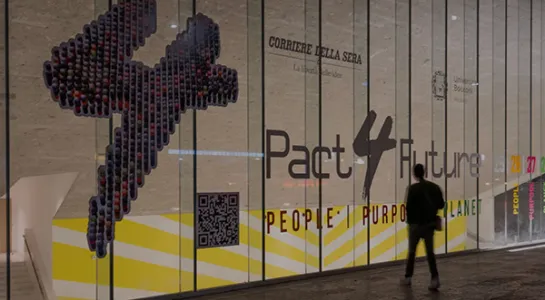
Interdependent. People, choices, planet
From March 24 to 26, Bocconi and Corriere della Sera return with the third...