
Generations in dialogue: the future as a shared responsibility
“If I have seen further, it is because I stood on the shoulders of giants”. Isaac Newton's phrase is not only a tribute to the past, but also an encouragement for the future. We can read it as an ode to the potential harmony between the innovative tension of the younger generations and the teachings of the more experienced ones.
There is a major change today in the succession between generations, compared to Newton's time, but also compared to the last century. Previously, each generation had a moment when it looked out of the window of history, only to then take its leave. Today, thanks to longer life expectancy, for the first time in history, several generations coexist. At the beginning of the 20th century, global life expectancy was just over 30 years; today it exceeds 73. In Italy, we have moved from 54 years in 1924 to over 83 today. Several generations are simultaneously present in families, workplaces, institutions and society. The world no longer has the shape of a demographic pyramid, with many children and young people and few elderly people, but an age structure in which the different generations have similar weights, if not unbalanced towards the elderly as in Italy.
Longevity is an extraordinary achievement. But it also becomes a challenge. When many generations live together, the temptation is to pit them against each other. Young people accuse older people of having consumed resources and opportunities. Older people look at young people as they have always done throughout history: “we were better”. These narratives may be seductive, but they are simplistic. Complex societies often look for scapegoats when they struggle to manage change. Today, all too often, the scapegoat is “the other generation”.
Institutions under pressure and imbalances to be measured
The problem is that many of our institutions were designed for a world that no longer exists. Pay-as-you-go pension systems worked when the population was young and large; today, with ageing, they are under pressure. In Italy, public spending on pensions accounts for almost a fifth of GDP. At the same time, public decisions – from public spending to environmental policies – have effects that will last for decades, affecting above all the lives of those who are now under 20 or not yet born. This is where the intergenerational pact comes into play.
To understand whether this pact is holding up, we need measuring tools, not just opinions. This is the aim of the Intergenerational Justice Index, developed by Vincenzo Galasso of Bocconi University as part of the European Age-It project. The index compares young adults (aged 25–34) and older adults on four crucial dimensions: economic equity, access to services, relational equality and political equality. The result is clear: in many European countries, including Italy, older adults are at an advantage, especially in terms of economic status and political representation, while younger adults pay a higher price in terms of job insecurity, housing difficulties and less influence in decision-making processes. The analysis also shows that no country is “in balance” on all dimensions: often, advantages in one area compensate for disadvantages in another, masking deep imbalances.
The political dimension is perhaps the most delicate. Across Europe, older people participate more in voting and are better represented in parliaments; party programmes tend to devote more attention to issues that concern them. Young people say they want to count, but in fact they count for less. In an ageing society, this imbalance is not just statistical: it risks becoming structural.
Opportunities, inequalities and social mobility
The longevity revolution has also created great opportunities. Living longer has made it possible to invest more in education. In 1900, only a third of adults worldwide had attended school; by the end of the 20th century, it was four out of five. Today, in OECD countries, almost half of young people obtain a university degree. The expansion of education has made societies more mobile and better able to harness talent that was previously wasted. It is one of the great drivers of economic progress.
Yet here too, the pact is fragile. Research shows that where economic inequality is highest, intergenerational mobility is lowest. If we do not reduce inequalities today, we are mortgaging tomorrow's opportunities. The generational conflict risks overlapping with a conflict between inherited destinies.
Responsibility towards those who will come
There is also a responsibility that goes beyond those who are alive today. In 1987, the Brundtland Commission defined sustainable development as that which “meets the needs of the present without compromising the ability of future generations to meet their own needs”. It is a powerful definition because it introduces into public discourse those who do not yet vote, protest or speak: future generations. In 2022, the Italian Constitution was also amended to include the protection of the environment and ecosystems “in the interest of future generations”. This is not a symbolic detail: it is the recognition that the time frame of politics must be as long as that of life.
In an era of technological acceleration and major environmental transitions, decisions have cumulative effects on generations. Every year of delay in the fight against climate change, every missed investment in education, every debt allowed to grow is an implicit transfer of costs to those who come after us. This is not rhetoric: it is the logic of a multigenerational society.
From coexistence to cooperation
We must learn to see coexistence between generations as a great asset. Studies on research teams and businesses show that generational diversity, when valued, increases innovation and improves performance. Different generations bring different skills, experiences and sensibilities. It is no longer a question of replacing one with another, but of creating alliances. This is why dialogue between generations must not be an exercise in good intentions. It is a condition of democratic stability. If young people feel excluded from decisions that affect them, trust in institutions erodes. If older people feel they are a burden, the sense of belonging is broken. The risk is a short circuit between demography and politics.
Generations in dialogue means recognising that the future is a shared responsibility. Those who have more years behind them have a duty to look beyond the immediate horizon. Those who have more years ahead of them have the right – and the responsibility – to participate in collective choices.
We cannot choose the era in which we are born. But we can choose whether to use this unprecedented coexistence between generations as a battleground or as an opportunity for cooperation. The future does not belong to a single generation. It belongs to those who agree to build it together.

Explore our Focus 'Pact4Future 2026'
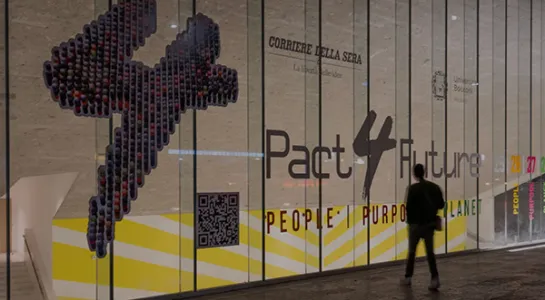
Interdependent. People, choices, planet
From March 24 to 26, Bocconi and Corriere della Sera return with the third...