
When Students Are Teachers of AIs
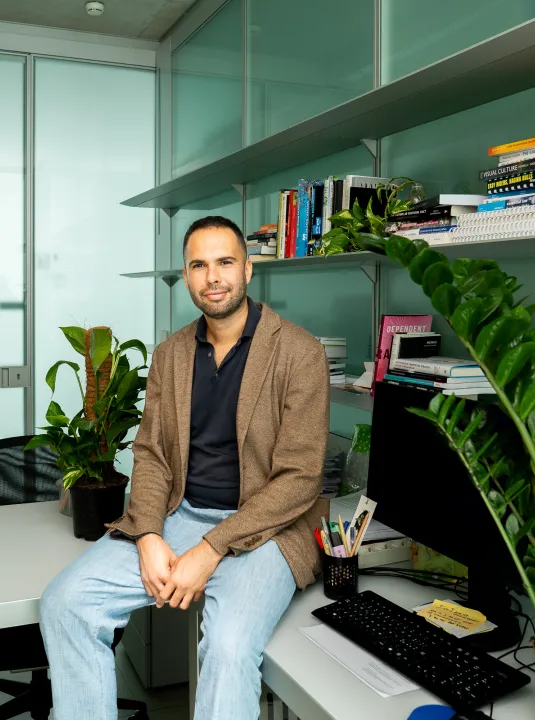
Not a tool you delegate your work to, but rather an interlocutor that needs to be challenged. This is the vision of artificial intelligence underlying the teaching project that Simone Autera, Lecturer at the Bocconi Department of Management and Technology, has developed for the course "The Global Industry of Imaginaries." Autera's approach overturns the relationship students normally have with this technology.
"I wondered," explains Autera, "how you could integrate artificial intelligence into teaching in a way that helped students critically examine their relationship with algorithmic machines." This reflection gave rise to the idea of encouraging students to turn into teachers, by having ChatGPT take on the role of the student.
A Matter of Prompts
The mechanism is as simple as it is effective. Through a structured prompt provided by Autera, students set up the conversation framework in which the AI responds as if the LLM were a learner on a range of topics chosen by the students (which are part of the syllabus students are expected to explore in class). Then, it's up to them to guide the AI, correct it and evaluate its responses.
The goal isn't to get the machine to answer correctly, but to stimulate the active learning of students. "By correcting the errors of the machine, they themselves solidify what they've learned in class," the Bocconi faculty member emphasizes. In other words, to "teach” the AI, students must first actually study, rework the content and master it themselves.
If You Understand It, You Can Teach It
This approach chimes with a specific pedagogical vision: knowledge is consolidated when you are able to transmit it. "The next step after studying is when you find yourself teaching things. If you can do it correctly, it means you have actually understood what you've studied," Autera explains. Artificial intelligence then becomes a testing ground for verifying your own understanding.
The project, which was given a Bocconi Teaching Award, involves between 20 and 30 students each year, organized into pairs. This choice is also no coincidence. On the one hand, it helps manage the workload; on the other, it aims to revive the often-overlooked collaborative dimension of the classroom. "I liked the idea of reintroducing the habit of exchanging notes, which is somewhat forgotten today," explains Autera. "Peer discussion proves to be a key element; many students have highlighted how working in pairs helped them fill knowledge gaps and clarify misunderstood passages."
Student Perspectives
It's not always easy work, but it's always stimulating, as one of the course's students, Lisa Cancellieri, 22, in her third year of the BEMACC program, emphasizes: "It was a very interesting assessment, which
really helped me stay on schedule with course assignments," explains Lisa. “The most challenging part were the answers ChatGPT gave us, because they were almost never structured the way my colleague and I expected, forcing us to ask to rephrase answers or making them more concise, as they tended to be too wordy. However,” she continues, “one of the things I appreciated most was the ability to use it to see how these concepts can be applied in real life. In each lesson, we asked the AI to explain concepts through concrete examples, which helped us better understand the topics.”
The results, according to Autera, exceeded initial expectations. The students not only strengthened their theoretical knowledge, but also learned to use artificial intelligence with a greater awareness.
“AI is also used in other courses, but here its use is guided, resulting in an almost personalized model,” emphasizes Christian Smeriglia, a 22-year-old in the CLEACC program. "Sometimes my colleague and I had to correct mistakes made by the LLM, which was very helpful in consolidating our knowledge. AI helps you learn much faster and is a benefit for students and teachers alike. But it's a support tool: nothing will replace a real, flesh-and-blood professor."
In times when there is fear that AI will replace studying, the course experience shows the opposite: if used methodically, it can become a tool for better learning. A training ground to develop critical skills and show students that the quality of answers depends, first and foremost, on the quality of the questions asked.

Students Compete to Design the Perfect Campus Mate
A hackathon organized in collaboration with Yellow Tech and OpenAI on 9 May brought together 120 students to develop artificial intelligence solutions aimed at improving university life. The competition, with...