
The Olympic spark
The Milan-Cortina 2026 Winter Olympic and Paralympic Games will be unlike any other, bound to stand out from all previous editions. They represent a paradigm shift in the very way the Games are conceived: for the first time with two locations in the name, combining the global dimension of Olympism with the authenticity of the host territories, from the city to the mountains.
A model aimed at enhancing existing or under-construction infrastructure that is already consistent with long-term development plans. Facilities that are – or will become – the best that Italy and the world can offer for each discipline. The natural beauty and organizational prowess of the territories will have to be squared with the complexity of an event that spans over 25,000 square kilometers and involves more than 5.5 million residents. An idea of the Olympics and Paralympics that is expanding, with its pros and cons, and that anticipates future models such as French Alps 2030 and Utah 2034.
The Games as a spark, not as an engine
This edition of the Games is not intended to be the engine of transformation, but the spark that ignites it. A catalyst for energies, skills, and projects already in motion, capable of amplifying them and making them visible on an international scale. The IOC awards the Games and with them the use of the five rings, one of the most recognized and valuable symbols in the world, effectively expressing excellence, respect, solidarity, and cooperation. The Games thus become a platform for attracting resources, investment, and new attention to sport. Medals and records will inflame the hearts of fans, but the impact, legacy, and value of the Games will be measured by the change they bring about in society and citizens.
The numbers of a legacy already in motion
Milan-Cortina 2026 has already sparked excitement since they were assigned in 2019, taking root in a country that – as recent official statistics show – is already on the move with increasing sport activity either occasional or regular. The Games represent an accelerator thanks to approximately €1.3 billion in new sports facilities and renovated structures; a workforce of around 3,000 people, supported by over 18,000 volunteers who will develop new skills related to the events; more than 300 legacy projects ranging from medical science to education, from facilities to inclusion. Eighty TV stations worldwide will be connected for more than 6,500 hours of live coverage, putting Italy at the center of the world for several days.
All this will activate the sporting ecosystem, generating impacts at multiple levels. Bocconi University has been asked to provide the official study measuring the economic, social, and environmental impacts and legacy of Milan-Cortina 2026 according to OECD and IOC guidelines. The IOC's mission is summed up in a simple and effective sentence: more movement for everyone, which means more facilities, more participants, more well-being, more athletes, more entertainment, and, as a result, a healthier and more sustainable economy.
Sport as a platform for social sustainability
For our society, sport must go beyond medals and field results. The book “Colori Olimpici” (Olympic Colors), written for and with Milano-Cortina 2026, advocates the idea that sport is central to social sustainability. It allows performance and excellence to be combined with mental and physical well-being. It is a way of life: it is about nutrition, quality of sleep, and healthy lifestyles. Above all, sport is social: it means teamwork, working with others, volunteering, embracing diversity, living in multicultural contexts, and building bridges between generations.
For all these reasons, countries that place sport at the heart of their economy are able to grow better in many ways, and cyclically seize the opportunity to host the Olympic and Paralympic Games to generate new change. This process must start in schools and universities, places where people learn about sport and make it part of their lives, moving from being athletes, volunteers, and spectators to becoming, tomorrow, professionals, sponsors, or investors.
A civic skill for the future of the country
This systemic vision reminds us that being an expert in sport does not just mean practicing it, following it as a fan, or owning a sports club. Sport is not an industry like any other: it is a universal civic competence that requires a cultural understanding capable of grasping its intersections, implications, and connections with other sectors. In this context, the Milan-Cortina 2026 Olympic and Paralympic Winter Games are not only just a major international sporting event, but also a strategic enabler for the Italian sports system and a multiplier of value for the country's economy, territories, and culture.
The challenge today is to transform this spark into a lasting impact, as a way of making sport a structural lever for well-being, development, and quality of life. In this perspective, an Olympic and Paralympic model ever closer to schools and universities represents a
strategic choice for educating of aware, responsible, and supportive citizens: champions on the field and in life.

The Book
Sport is a powerful driver of economic, social, and cultural development, and the Olympic and Paralympic Games are the spark capable of expanding opportunities and perspectives for everyone, as Dino Ruta explains in the book Colori Olimpici (Egea, 2025, 256 pp., €13.90, in Italian).
Explore our Focus 'Milano-Cortina 2026'
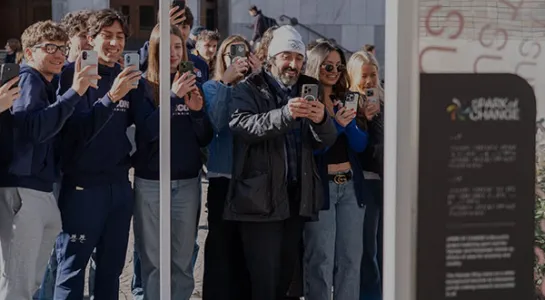
sPark of Change: at Bocconi, the Olympics Become an Experience Worth Exploring
Starting February 6, Bocconi University hosts sPark of Change, an exhibition...