
From Expo to the Olympics: Milan Faces the Test of Global Maturity
Not much more than ten years after the Universal Exposition, Milan is hosting another major event: the Milan Cortina 2026 Olympic and Paralympic Games.
We are nearly there. The healthy tension of anticipation is palpable. Expectations are undoubtedly high that this event will follow in the footsteps of Expo 2015 and prove a success for the city.
However, the requisites for success are there, today as back then.
Having overcome the customary skepticism with which international events are often approached in Italy, the facilities are ready to open their doors to the competing athletes, their staff, and the many supporters from all over the world. The city has been decked out in the colors and logos of Milano Cortina 2026. The Olympic atmosphere can be felt.
With the Winter Games, Milan has a new opportunity to show its ability to manage world-class events and to reaffirm the international reputation that had developed becoming firmly established thanks to the Universal Exposition.
If today Milan is not just a city for fashion, design, and business but is also globally recognized as a tourist destination, a culturally thriving and attractive hub, and a political and institutional reference point—both nationally and internationally—it is certainly due to the favorable context and climate of collaboration in which Expo 2015 unfolded.
The stimulus and push for development that the event gave to Milan did not end when the gates closed on October 31, 2015, but carried on enthusiastically in the following years. We have all seen this.
I am proud to have led the city in this phase of renewed vitality.
Expo 2015 was a turning point for Milan, spurring our city to grow, regenerate, believe in its potential, and commit itself to realizing it, with the courage of those who know they can count on an economic, social, and institutional network that can work as a team to achieve common goals.
I am convinced that without the wealth of knowledge acquired during that period, Milan would not have dared to even think about hosting the Winter Olympics and Paralympics. We don't have mountains, so how could we have won the bid? Instead, we created a system, joined forces and ideas, and, for the first time in the history of the Games, proposed Olympics and Paralympics across a wide area involving the mountains of Lombardy, Veneto, and Trentino-Alto Adige, as well as Verona and our own city.
Of course, the road that led us here has not been all smooth sailing: there were moments of tension and concern, such as when it was necessary to find alternative venues to host some of the competitions. However, the determination to achieve the goal never wavered, nor did the confidence that we would be able to honor the commitment we had made.
Another thing is certain. For better or worse, the city that bid farewell to Expo is not the same one that will welcome Milano Cortina 2026. Today, Milan is a more open, lively, enterprising, and contemporary city, but it is also a city where—like other major cities around the world—socio-economic differences have become more acute and which is seriously addressing housing, environmental, and many other challenges. Furthermore, the international historical and political context in which the Games are being held is complex and unstable: an Olympic truce has been declared, and we hope it will be respected.
That is why I am experiencing the eve of Milan Cortina 2026 with serene, proud emotion. That is, with the serenity of someone knowing to have worked effectively to achieve the goal, with the confidence that the 'Milan machine' – and by this I mean the reception, hospitality, transport, cleaning, cultural, gastronomic, commercial, and entertainment offerings—will work and do its part well during the weeks of the Games, with the excitement of someone who loves sports, practices them, and can't wait to watch great performances, and of course with the pride of having given the city he administers and his country a new opportunity to be appreciated in the eyes of the world.
The Winter Olympics and Paralympics will be a big step in a process already underway, thanks to which Milan will consolidate its status as a place to be and a venue suitable for hosting any kind of international event. Milan Cortina 2026, with maturity and pragmatism, will help lead the city towards a future based on truly equitable, inclusive, and sustainable growth.
Because, in addition to the facilities that will remain in the city—the Santa Giulia Arena, the event venues built at Rho Fiera, and the student housing that the Olympic Village will be converted into—the most profound and important legacy that Milano Cortina 2026 can leave to our city are the values of equality, unity, and peace that the Games embody.
Explore our Focus 'Milano-Cortina 2026'
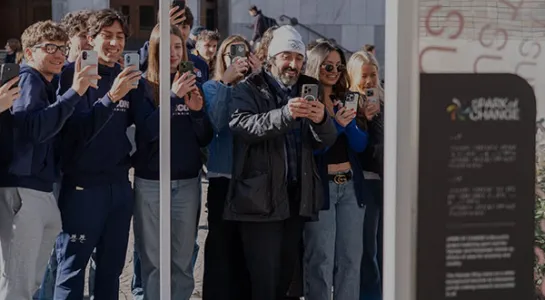
sPark of Change: at Bocconi, the Olympics Become an Experience Worth Exploring
Starting February 6, Bocconi University hosts sPark of Change, an exhibition...