
Leading a Small Town to a Global Event
Planning, research, agreements, a vision focused on results as well as on the future. Organizing an event like the Milan-Cortina Winter Olympics requires more than just the already robust know-how gained from thirty years of hosting World Cup ski races. This is according to Bocconi alumna Silvia Cavazzi, mayor of Bormio, one of the two Valtellina locations chosen for the event. “The word we repeat a hundred times a day is ‘legacy’, that is what we will leave behind after the Olympics.”
How do you manage the good and bad aspects of an event like this?
The Olympics are the celebration of sport par excellence, but managing an Olympics involves a great deal of responsibility. And in the case of a town like Bormio, which has a mere 4,000 inhabitants, the responsibility of a small town becomes an international responsibility. Any delay, error, or hiccup in the schedule of works and activities means making the Lombardy Region and the whole of Italy, which chose us for this great event, look bad. This is to say that every now and then you feel a thrill.
Bormio has been hosting the Alpine Ski World Cup for thirty years, a major international event. Is managing the Olympics more complex?
With the World Cup, of which we host the Super-G and Downhill events, we are more than experienced in assessing what tasks and infrastructure need to be ready. But with the Olympics, everything is on a much larger scale. The Olympics involve the whole region, hundreds of volunteers, the media, commercial and institutional partners. All this is also true for the World Cup, but not at this level. With the Olympics, institutional contacts are with the consulates of the various countries. And everyone wants to talk to the mayor. In addition to the infrastructure, there is also content management, for which we are in daily contact with the Lombardy Region and the Milano-Cortina Foundation (the organizing committee).
A challenge for human capital too
We have a municipal staff that is obviously sized for the needs of 4,000 inhabitants, even though ours is a municipality with a strong tourist vocation. So it was complicated at first, we had to recruit staff to follow the event and we created a specific delegation for the Olympics for the Department of Tourism and Major Events. We are a group of municipal councilors who are all sports enthusiasts because Bormio and Valtellina are places for sports. In fact, the Olympics were precisely what motivated my candidacy and that of my group in 2021. It was already established that Bormio and Valtellina would be venues for the event, because Milan-Cortina had won the bid for the Olympics in 2019. So I said to my group, “Do you want to watch the Olympics from your sofa at home, given that we will have them in Bormio?” I ran for mayor because I wanted to be at the forefront of this game.
How difficult is it to bring together the needs of so many different stakeholders?
Sometimes it looks like an impossible mission: a fast-moving machinery, where you have to respect timetables, procedures are increasingly complicated, anti-corruption, transparency, supplier rotation. And then there’s the superintendency [the authority overseeing cultural heritage], the landscaping. There were times when I was heavily criticized, but now people see the result, and that’s what they want.
Let’s talk about legacy. What do you expect for your area from Milan-Cortina 2026?
There is a territorial legacy linked to infrastructure, which becomes even more important in areas with low population density such as ours. Areas that, under normal conditions, do not have enough electoral clout to shift attention on the works they need. So Olympic infrastructure must obviously be designed for the recurring needs of this area.
Then there is an organizational legacy linked to human capital: the Milano-Cortina Foundation has recruited many young people from the area to work on the committee. This is important for us because these are young people who are learning how to manage a major event, which is essential know-how, also psychologically, so as not to remain stuck in the same organizational patterns.
Finally, it is clear that the Olympics are expected to have a positive impact on development: more work for companies in Valtellina and an increase in tourist numbers in the area, estimated at around 20% in the coming years.
Is the agreement with Niguarda Hospital also part of the Olympic legacy?
Yes, it is an idea of Mr Bertolaso, Lombardy Region Welfare Councilor, and Mr Melazzini, Regional Welfare Director General: the aim is to link an internationally renowned facility such as Niguarda to our mountain hospitals in Sondrio and Sondalo, in order to strengthen our local healthcare system.
Before combining administration and sport in the organization of the Olympic event, these two elements were already part of your life individually. Who is Silvia Cavazzi?
Until I was nineteen, I was an athlete, I was in the national junior cross-country skiing team. An Olympic medal is every athlete’s dream, and I won’t hide the fact that the Olympics were also my dream. Maybe I didn’t believe in it enough, but it’s also true that reaching the top is hard, partly because I often competed against athletes like Stefania Belmondo and Gabriella Paruzzi, who went on to win medals. And I wasn’t at their level. Moreover, at that time, I was also very interested in studying, which is why I enrolled at Bocconi University, where I graduated in 1996 with a degree in business economics.
What did sport teach you?
Discipline, a sense of duty, but also a focus on results. I always strive for results, so much so that I sometimes find it difficult to accept when they don’t come. It also teaches you to persevere. Before you see a project completed—I’m thinking of Olympic infrastructure, for example—you have to persevere through all the planning, all the authorizations, all the protests. You have to keep your priorities clear in your mind and not let criticism and comments upset you too much, otherwise you lose your focus and therefore the result. Sometimes people tell me I’m a bit authoritarian.
Explore our Focus 'Milano-Cortina 2026'
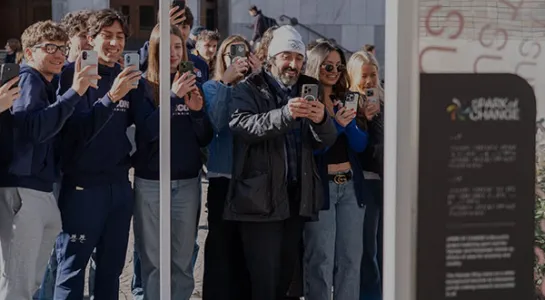
sPark of Change: at Bocconi, the Olympics Become an Experience Worth Exploring
Starting February 6, Bocconi University hosts sPark of Change, an exhibition...