
Transport Under Attack: Energy, Routes, New Balances
The world seen from a porthole, whether on a long-haul aircraft, a cruise ship cabin, or an oil tanker, will not be the same for a while after Saturday, February 28, with the coordinated attack by Israel and the US on Iran and the ensuing response on many fronts.
Hormuz and the global energy shock
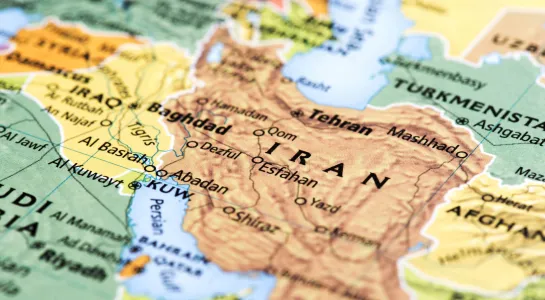
The Iranian response is completely unlike the past, as it involves many states in the area, including Qatar, Saudi Arabia, and the United Arab Emirates. It also targets civilian targets, including ports, airports, and industrial areas, with drones and missiles. In addition, there is the threat of blocking the Strait of Hormuz, a passage only 34 km wide that is vital for energy flows to Asia and Europe. In fact, according to Alphatanker data for 2024, 34% of the world’s seaborne crude oil, 25.6% of gas, 18% of LNG (including that from Qatar, which is the second largest exporter to Italy) and 14.4% of refined products pass through there.
The consequences on the energy market, considering that even today well over 90% of global transport still depends on traditional fossil fuels, are the focus of attention and a source of uncertainty and concern for all economic operators, particularly those offering transport services, including European road hauliers.
Closed airspace and networks to be redesigned
The anomaly of Iran’s response, which led to the closure of airspace and airports of great importance for long-haul travel in the Middle East and between Europe and Asia, such as those in Dubai (second in the world for passengers and 11th in the world for cargo) and Doha (33rd in the world for passengers and 8th for cargo), makes it particularly hard to understand the depth and duration of the effects on the air transport sector. In fact, the Gulf area, particularly since the closure of Russian airspace to most Western carriers since 2022, is a global hub for passengers and cargo, and with the classic butterfly effect reverberating through direct and indirect interconnections even in the most remote corners of the world, even routes between Malpensa and New York, where Emirates operates, are affected.
Flight cancellations on a scale unprecedented except during Covid and longer journey times require a large-scale redesign of the network. Moreover, the share prices of all major global carriers fell rapidly in the early days of the week, both because investors understand the effects of lost revenue on long-haul routes, typically the most profitable and with the most attractive growth rates, such as those between Europe and Asia, but also because of the unexpected increase in costs, in terms of both significance and possible duration, due to the rapid rise in oil prices, which has a direct impact on the price of jet fuel. On average, 25-30% of total operating costs depend on this item, with peaks of almost 40% for low-cost airlines, which are in fact among the most penalized on the stock market in recent days despite operating almost entirely outside the Middle East. None of the major Middle Eastern carriers will be forced to scale back their long-term ambitions as they are all directly supported by states that will benefit from the increase in energy prices, but the effects on Western airlines could be significant even if oil prices rise no further than what we have seen three days after the start of the new conflict.
Maritime transport: between crisis and new opportunities
The effects of the new war front on the maritime sector are much more complex. The cruise sector alone saw the value of companies’ shares fall sharply in the early days of the conflict. The sector is actually only directly affected by the inability to operate in a very limited market (less than 1% of world cruise ship capacity is located in the Middle East), but the sector is generally suffering from the uncertainties and fears generated by the attacks on hotels in Dubai, which will hopefully have only temporary effects. The fact that the cruise ship MSC Euribia is stranded in Dubai with many Italian guests on board has a direct impact on the domestic market.
In all other segments of the maritime sector, revenues and profits are expected to increase, despite the very serious disruptions that, for example, have left hundreds of thousands of containers stranded in the area’s port terminals, theoretically bound for Europe, and the general increase in operating costs, including insurance costs, which have skyrocketed. In fact, the reactions of share prices on the various stock markets of Maersk and Hapag Lloyd (specializing in container traffic), Hoegh Autoliners (transport of new cars from Asia to Europe), and Frontline and Scorpio Tankers (transport of liquid bulk) have been particularly positive. In these market segments, although all the major shipping companies have announced that they do not intend to operate in the Arabian Gulf and the Red Sea, the increase in mileage and delays due to the passage around the Cape of Good Hope, rather than through the Suez Canal, and restrictions on operating capacity will lead to higher shipping prices. These effects thus mitigate concerns about possible excess cargo capacity in certain sectors, such as containers, which in recent months had led to downward trends for several operators in the sector.
Winners and losers in a more fragmented market
As in all conflicts, there will be winners and losers in the transport sector in this new, increasingly risky and fragmented market environment. The key issue is that the number of economic operators who will be severely affected by the increase in transport costs and times is significantly greater than those who will benefit from the prospect of new revenues.
Today, the porthole looks onto a more uncertain horizon with increasingly dark shades.

Explore our Focus 'War in the Middle East'
War in the Middle East: Energy, Alliances and Global Routes
The war between the US, Israel and Iran has dragged the Middle East into a high...