From Toilets to a Better World
"Be the change you want to see in the world"- Mahatma Gandhi It is the fifteenth village visited within the course of one month, and by now my eye has become accustomed to the scenery of rural life in one of India's most economically-depressed states – Jharkhand. Nevertheless, it was this Shyamsunderpur village of the Chakulia block which became the turning point in my perception of the entire social development concept. And it is very ironic that the symbol of the community empowerment whose positive signs I detected in Shyamsunderpur was ... a toilet.
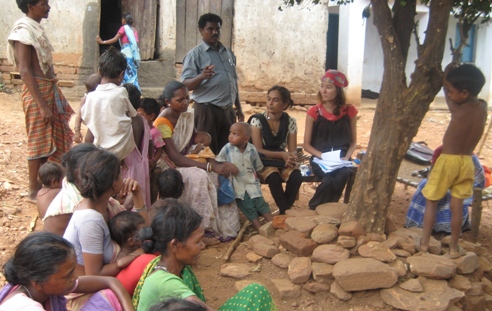 Kamila talks with people from the village |
Allow me to elaborate.
Shyamsunderpur was the only village I visited where it was the local community itself that took the initiative of building a four-wall construction with a hole in the ground similar to the one which I used in my grandparents' house in Southern Russia during my childhood. In order to convey the full magnitude of the excitement I felt while walking from one house to another and taking photographs of those solid constructions, I need to mention a few statistical facts.
India is a country where 69% of the rural population still defecates in the open, and 638 million people do not have access to toilets, according to the recent statistics jointly released by the WHO and UNICEF. Although the overall social development indicators have improved radically during the past decade - primarily thanks to a number of flagship programs launched by the Government of India jointly with United Nations and projects implemented at the grass root level - issues related to sanitation and hygiene still remain a growing concern to the national policy makers and local NGOs. In its attempt to achieve 100% sanitation coverage by 2012, the government financed installation of squat toilets, keyhole-shaped bowls that were placed either directly on the ground or on elevated platforms, without the surrounding walls.
In every single village prior to my visit to Shyamsunderpur, locals had failed to use those constructions, preferring to go to the nearby fields even though one or two squat toilets had been set up for their use. And every single time during my focus group discussions I fully empathized and sympathized with the local villagers, supporting their angry accusations of how the government that had failed to install more "user-friendly" constructions, and "how disgraceful it is to use a toilet with no walls" especially in such a reserved culture as India's.
Only in Shyamsunderpur was I enlightened, and my perception regarding the economic development issues was finally formed. Hundreds of individuals prefer to fall victims to various health hazards, contaminating soil and water, while expecting government to step in and fix the problem. I completely agree that it is the obligation of the State to meet those basic expectations of its citizens and ensure the timely and effective provision of various services, but I cannot help but think that sometimes it only takes a marginal degree of local effort to construct toilet walls, so that at least one family has a healthier and more prosperous lifestyle.
The toilet example is very India-specific, and it is difficult to relate it to other more developed countries that have not faced such sanitation problems since the Middle Ages. However, there are some similarities in terms of mentality, as failures to act by numerous firms and individuals are justified exactly by this reason of an absent "green light" from the government. Yes, it is true that many Indians are vocal about their dissatisfaction with the government's course of action, and some of them still expect the authorities to build a toilet in every single household. But it is this same India, my incredible India, that became the incubator of the most innovative social entrepreneurship ideas, all of which have been launched at the micro-level and then followed a bottom-up flow.
While Grameen bank's model is indisputably one of the most effective tools that have ever been utilized for poverty alleviation purposes, it is the concepts underlying India's Self-Help Groups (SHGs) that fascinate me the most. A SHG is a village-based microfinance intermediary that consists of 10-20 local women, and it accumulates the pool of savings' contributions that are later extended in the form of loans to other members, as well as non-members. According to the latest figures, approximately 4.7 million of SHGs operate in India at the moment, and the numbers grow exponentially every month.
The idea is very innovative in its simplicity, as it is based on the concepts of mutual trust and community spirit which create peer pressure and ensure the timely repayment of the loan. Because of the "lack of trust" factor, it is challenging to replicate the SHG model in developed countries where there are also certain marginalized groups that do not have access to capital markets. The fact that SHGs have also access to depository services via opening a collective account and depositing aggregated savings contributes to its success story even further, as microfinance initiatives which serve as alternative financing sources to economically-disadvantaged groups have lending capacity. But apart from the provision of needed financial resources, SHGs is another successful example of the community-action movement that initially was created as an outcome of forced self-reliance, and eventually became a catalyst for community empowerment.
We all have a predisposition for external attribution, and in most cases there we have every right to blame the evil government. But at the end of the day we, as individuals, are quite capable and powerful enough to make our microenvironment a healthier and safer place: maybe building toilet walls in our own households would be a good way to start.