
Bocconi Opens Its 125th Academic Year: Turning Destiny into Possibility Through Education
To make education not the confirmation of a destiny, but the beginning of a possibility. This is the commitment Bocconi University made today as it opened the 2026–2027 academic year, the 125th in its history. The University placed social mobility at the center of a reflection on the role of universities in building a more open society capable of generating development.
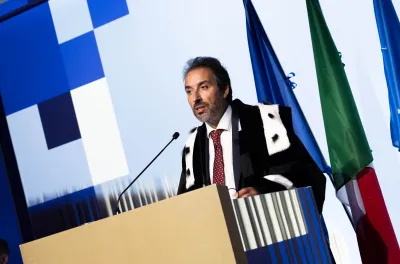
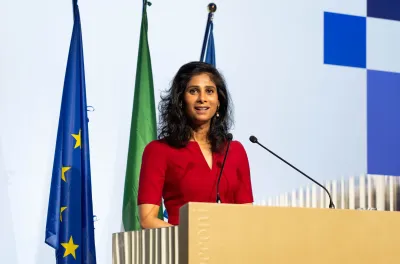
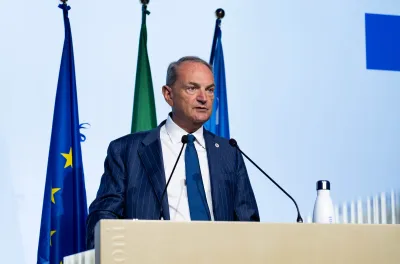
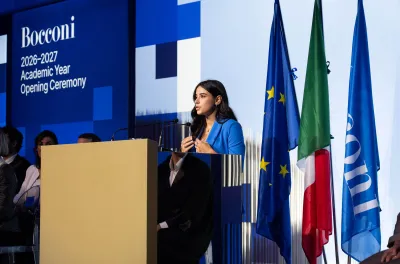
The ceremony, opened by President Andrea Sironi, brought together all parts of the Bocconi community in the Aula Magna. Giulia Gambardella, a representative on the University Board, spoke on behalf of the student body. Her remarks were followed by an address by Riccardo Taranto, Managing Director, who will complete his term in November, and Rector Francesco Billari’s address. Gita Gopinath, Gregory and Ania Coffey Professor of Economics at Harvard University, concluded the morning with a keynote lecture entitled, The Future of the Global Economy and Your Role in It.
The day centered on a question that concerns not only universities but society as a whole, asking how much the circumstances into which people are born still shape the opportunities available to them throughout their lives.
“The quality of a university is measured not only by its ability to attract and educate talented people, but also by its willingness to recognize its responsibility to society,” said Andrea Sironi, Bocconi University President. “This is the direction set out in the Bocconi Strategic Plan 2026–2030 and Vision 2035, which aim to ensure that Bocconi remains an independent, international institution committed to excellence, capable of integrating the social sciences with other sciences and using new technologies thoughtfully and responsibly. Access, inclusion, research, innovation and social impact are all part of a single project, expanding opportunities without compromising quality.”
An Open Society Does Not Waste Talent
In his address, Education and Social Mobility: Open Societies Generate Development, Francesco Billari described the role of education as the primary social and democratic infrastructure that, throughout history, has been capable of weakening the link between social background and destiny.
Social mobility, he emphasized, is not merely a matter of equity. When abilities and talent do not find opportunities, society as a whole loses out: innovation, productivity and growth decline. The so-called “lost Einsteins” and “lost Marie Curies” are talented people who do not have the opportunity to fulfill their potential — not because they lack ability, but because income, gender, family environment and networks continue to shape individual opportunities.
“Talent is everywhere, opportunities are not,” said Francesco Billari, Bocconi University Rector. “For this reason, opening the doors is not enough. We must ensure that those with talent know those doors exist, can pass through them and, once inside, find the conditions they need to stay, grow and make a difference. Social mobility and excellence are not competing goals: a more open society makes better use of its talent and generates more value for everyone.”
Billari noted that inequalities begin long before university: in early childhood, at school, in family expectations and in middle school guidance processes. They can then continue throughout the education path and even after graduation, affecting access to employment, professional networks, entrepreneurship and lifelong learning opportunities.
More Than €350 Million to Support Students
Bocconi’s commitment spans this entire journey. Through Bocconi4Access to Education, the University provides a system of financial aid based on academic merit and financial need.
Today, as in the University’s early years, one in three students receives some kind of support, which may include full or partial tuition coverage, a scholarship or accommodation. Notably, more than 1,900 students study free of charge thanks to a full tuition waiver.
In 2025, total investment in student support amounted to €57 million. Bocconi plans to allocate more than €350 million to this commitment over the five-year period from 2026 to 2030.
Accommodation is also a key component of accessibility, especially for students from outside Milan. The University’s residence hall system now offers approximately 2,800 beds, including 700 new places at the Olympic Village.
These measures are complemented by programs for students who may not be reached by standard student aid channels. The Una Scelta Possibile project, launched in the 2013–2014 academic year, has involved 187 students from socially and economically underprivileged backgrounds over 13 editions. Among participants, 95% have graduated.
Through the Bocconi Inclusion Programs, this commitment extends to students with refugee backgrounds and high-potential students from contexts of poverty, political instability or conflict. In the 2026–2027 academic year, the program is welcoming 36 new students from 16 countries, including five from the Gaza Strip.
Bocconi’s entry into Merito e Mobilità Sociale (Me.Mo.), a national program promoted by Scuola Superiore Sant’Anna and developed with the MERITA Network, also strengthens efforts before university admission, when self-selection, opting out and a perceived distance from university can take shape.

From Access to Artificial Intelligence
Today, social mobility also depends on access to new technologies and the ability to use them. Artificial intelligence can greatly expand opportunities for learning, research and work, but it can also create a new divide between those who already have tools, skills and supportive environments and those starting from a less privileged position.
Bocconi is therefore working to make AI proficiency genuinely accessible to the entire student body. The Strategic Plan calls for stronger technological infrastructure, the integration of AI tools into teaching and the development of broad-based skills for their expert, critical and responsible use. This includes agreements with leading global industry players such as OpenAI, Google and Anthropic, as well as the adoption of specialized legal platforms such as Harvey, Legora and Lexroom.
The goal is not simply to make new tools available to students, but to embed their use in learning processes and make them part of every student’s skill set. In this sense, access to AI is also a matter of social mobility: preventing a technology destined to profoundly affect study and work from becoming another advantage reserved for those who are already ahead.
Social Mobility Continues in the Workplace and Throughout Life
Social mobility does not end with university admission or even with graduation. The transition to the workforce may also be shaped by social background, access to networks, the ability to accept low-paid or unpaid internships and the confidence to negotiate within organizations.
In his address, Billari also described the “class ceiling,” barriers that can slow career progression for people from less privileged backgrounds even when they have equivalent qualifications. For businesses and organizations, countering these mechanisms is not merely a matter of equity: it means making better use of available human capital and broadening the diversity of experiences and perspectives in decision-making processes.
In an era of longer lives and increasingly rapid technological change, social mobility also concerns the ability to keep learning, update skills and build new career paths. This is where lifelong learning becomes an integral part of equality of opportunity. If access to continuing education remains concentrated among those who already have more resources, technological change risks widening rather than narrowing inequalities.
Since 2022, SDA Bocconi School of Management has allocated €5 million each year to scholarships and tuition waivers for Master programs. On average, approximately 250 participants per year — 27% of Master students — have benefited from these measures. Again since 2022, €1 million per year has been allocated to promote women’s access to open executive courses.
Beginning in 2027, in accordance with the SDA Bocconi Strategic Plan, this support will be further strengthened through the introduction of the new Learning Without Limits fund, designed to provide access to executive programs for participants and organizations that could not otherwise benefit from advanced education opportunities. The goal is to extend the principle of accessibility beyond the university years, supporting people and organizations throughout their professional lives.
Building Opportunities That Last
The Opening Ceremony also provided an opportunity to recognize the contribution of Riccardo Taranto, Bocconi’s Managing Director and an alumnus, who will complete his term in November 2026 after helping guide the University’s growth and transformation in recent years.
“A university fulfills its mission when it turns a vision into organizational capacity, services, spaces and resources available to students, faculty and society,” said Taranto. “What matters is building strong institutions that can evolve and enable projects to continue well beyond any one individual or their individual role.”
Bocconi’s nonprofit status reflects this same perspective: the resources it generates and raises are reinvested in teaching, research, student support and the University’s development. The same principle underpins A Place for the Future, the fundraising campaign through which Bocconi aims to raise €200 million by 2030. Between 2021 and 2025, more than 6,700 Donors made it possible to raise €90 million. Student support accounted for 47% of gifts, and in the 2025–2026 academic year, 380 students received financial aid thanks to Donors.
“We Built It Together”
The Opening Ceremony concluded by focusing on the message of We Made It, which accompanies Bocconi’s 125th year.
Not merely “we succeeded,” but “we built it together.” Because behind every journey of social mobility are people, families, teachers, institutions, Alumni and communities that have helped make each step possible.
“A university cannot correct every inequality on its own,” Billari concluded. “But it can — and indeed must — decide whether to limit itself to selecting talent that is already visible or to create the conditions for other talent to become visible. This is the commitment we make as we open the new academic year: to make education not the confirmation of a destiny, but the beginning of a possibility.”

The Bocconi Community Invests in the Future
With the A Place for the Future campaign, fundraising has now surpassed €110...

Filippo Gori Is the 2026 Alumnus of the Year. Awards Will Also Be Given to Anna Fiscale and Giada Zhang
The Bocconi Alumni Community honors three careers that have made an impact in...

Bocconi to Complete Its Campus: Two New Buildings and a Nursery School for Local Families
Construction for a new nursery and of the buildings at Via Bocconi 6–8 signal a...

Bocconi by the Numbers
From the community to teaching, from relations with the world of work to...