Andrea and Barbara in Bangladesh with an IDEA
Inside Bocconi's walls, Andrea Borghi and Barbara Alfieri work with advanced technologies used to run the most hidden but most vital aspects of the university. Outside its walls, they are faced with the worst poverty in Bangladesh. For Andrea, part of the Bocconi IT Services (ASIT) team and Barbara, who works at SDA Bocconi's Information Technology Service, something that for many people is a normal move from virtual reality to the real world occurs for them as radically as possible: since 2007 they have dedicated their free time to IDEA Onlus (www.ideaonlus.org), an association they co-founded with two other friends to create and develop child sponsorship, social and healthcare assistance projects and projects promoting education in the South-East Asian country.
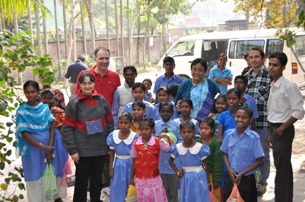 Andrea Borghi (in the red shirt) with a group of children in Bangladesh |
IDEA Onlus is the latest step in social work that has brought Andrea to Bangladesh since 1997. That was the year in which he sponsored a little girl from Bangladesh through the non-profit organization Rishilpi Development Project. "I decided to see her in person to understand what it's really like to live in that country," says Borghi. It was an exposure to a world that was very far from his own and not just in terms of geography. "You can only fully understand the devestation of a population living in a slum in the forest if you see it in person." It was a personal experience that began to consume him, though it didn't turn into a concrete commitment right away. "I just started talking about child sponsorship at the office, more to tell people about my experience than as a way of promoting the Rishilpi mission. In the end, sponsorships at Bocconi reached a total of two hundred." That was the moment in which Andrea's view of the problems in Bangledesh started to change. In 2002 he returned to the country with Barbara, who had he met in '97 and married in the following years. After they came back to Italy they decided to found a branch of Rishilpi in Italy, in Pinerolo. It was a business that lasted four years, until the couple decided to go even further. "We wanted to be able to do more. That was how IDEA Onlus was started."
Founded in 2008, IDEA can operate all over the world and currently has an active projects in Mato Grosso, Brazil and three projects in Bangladesh. One of these, carried out in collaboration with the Bangladeshi non-profit organization Banchte Sheka and created as a child sponsorship project for social and healthcare assistance for children, has turned into an attempt to save an entire community. "We operate in Jogahati, a fishing village whose activities were completely upset when a section of a canal used by the community was sold to a private party. The inhabitants were allowed to fish only for their own survival and not for sales, a condition that devestated the village." The work of Andrea, Barbara, Gabriele and Maria (the two friends who co-founded IDEA), along with the local non-profit organization, was used to build ten new houses for the poorest members of the community, "people who in some cases currently live under a rented outdoor canopy," says Andrea.
Since founding IDEA, Andrea and Barbara have sponsored an entire family (a woman who escaped from an abusive husband with her two daughters). He is adamant about the importance of not abusing the welfare state ("IDEA's idea is to transform the village into a co-op that over time becomes the real engine of the community's rebirth") and about the mark that experiences like these leave on well-to-do Europe. "These are societies in which social and cultural differences do not allow adults and children to have relationships. These are communities in which an invalid is literally emarginated, in the sense that he or she will be picked up and thrown into a trash heap. These are places where children dream of a glass of clean water. By seeing this extreme poverty we should not simply re-evaluate what we do, we can also more fully understand how much these situations are often the result of rich countries speculating over poorer countries."